
By YES-Europe’s COP30 Project Lead and German Youth Delegate to the UNFCCC Caterina Bittendorf
Coming home from COP30, held in Belém, Brazil, it’s time to rewind and reflect.
Safe to say, COP30 was historic in its symbolism: Nestled in the Amazon rainforest, it marked the tenth anniversary of the Paris Agreement and was billed as the “implementation COP” and “COP of truth” by the Presidency. For us as young advocates, this was supposed to be the moment when promises turned into real, urgent action. Instead, many left with mixed emotions: energized by the visibility of child and youth voices, but disappointed by the lack of decisive commitments
Let’s take a closer look at it:
What was achieved?
- Mutirao Decision acknowledging intergenerational equity, gender equality and human rights – sadly no primary consideration of children or strong language on legal obligation to prevent harm for future generations
- Adoption of a Global Goal on Adaptation – with work on indicators continuing next June in Bonn (SB64)
- Adoption of the Just Transition Work Programme – the Belem Action Mechanism (BAM) became reality
- Adoption of a 9 year Gender Action Plan that for the first time recognises care work, relevant issues, and women environmental experts – it’s not what we wanted, but it’s so much more than we expected
- Reaffirmed commitments to climate finance and adaptation, but failed to deliver binding timelines for ending fossil fuel subsidies
- Presidency initiative for a roadmap for fossil fuel phase-out and a roadmap to end deforestation – disappointing results, as though it’s not completely off the table, we need a binding commitment to a full fossil fuel phase out
For us the outcome felt “painfully familiar”: acknowledging urgency without matching it with action – as highlighted in the closing plenary.
The Closing saga
This became especially apparent when in the closing plenary session – or how I say, COP30 Closing Saga – Colombia alongside several Latin American countries objected to the just gaveled decisions that were passed despite their objections and hands raised. In particular they affirmed that a COP decision without even mentioning the word fossil fuels once is unacceptable and cannot be tolerated by them – supported by screams and applause from civil society.
A shocking moment was the insulting language Russia used towards LAC countries calling them “children that want all sweets”, which was met by a legendary clapback from Panama reaffirming child rights, children’s intelligence and hope that negotiators would learn from the brilliance of children. A speech met with cheers and echoes of support.
All in all this day of closing plenary showed how tense and political COPs are. But it also showed how many negotiators actually care and fight for a livable future for all. It was inspiring to see how Colombia as well as others stood up and fought until the last minute for ambitious climate policies that so many of us want to see.
But the closing saga also showed us once more that common sense is not common and things that seem as just given for us, are not on the international stage. For example highlighted (once againnnn) by the Holy See who needed to voice their somewhat daily affirmation that they only recognise two genders and won’t accept language on reproductive rights – basic human rights as we say…
It becomes visible that it was tense negotiations until the last second, and a very long day in the plenary room. Luckily my friends supported me with enough snacks, emotional support and a few new stickers – sitting next to me as well as from afar. It really is a young community fighting for climate justice.
Youth voices at the forefront
Young people were present throughout the whole duration of COP30 fighting for ambitious climate policies in the hallways, bilaterals and negotiations. As well as with several events to shed light on our needs and realities. Highlights included:
- Youth roundtable hosted by UN Secretary-General António Guterres emphasized the “decisive battle” to phase out fossil fuels, urging young people to keep pressure on negotiators and reaffirming the essence of intergenerational equity – featuring YES-Europe’s COP30 Project Lead, Caterina Bittendorf, as one of 5 selected speakers
- Child and Youth organizations demanded genuine co-leadership, not tokenistic representation. They called for funded access, inclusion in national delegations, and recognition of youth-led innovation
- Event on Equity and Science in NDCs (co-organised by Care About Climate, YES-Europe and PUSH Sverige) calling for greater child and youth inclusion as well as building local policies on Indigenous knowledge
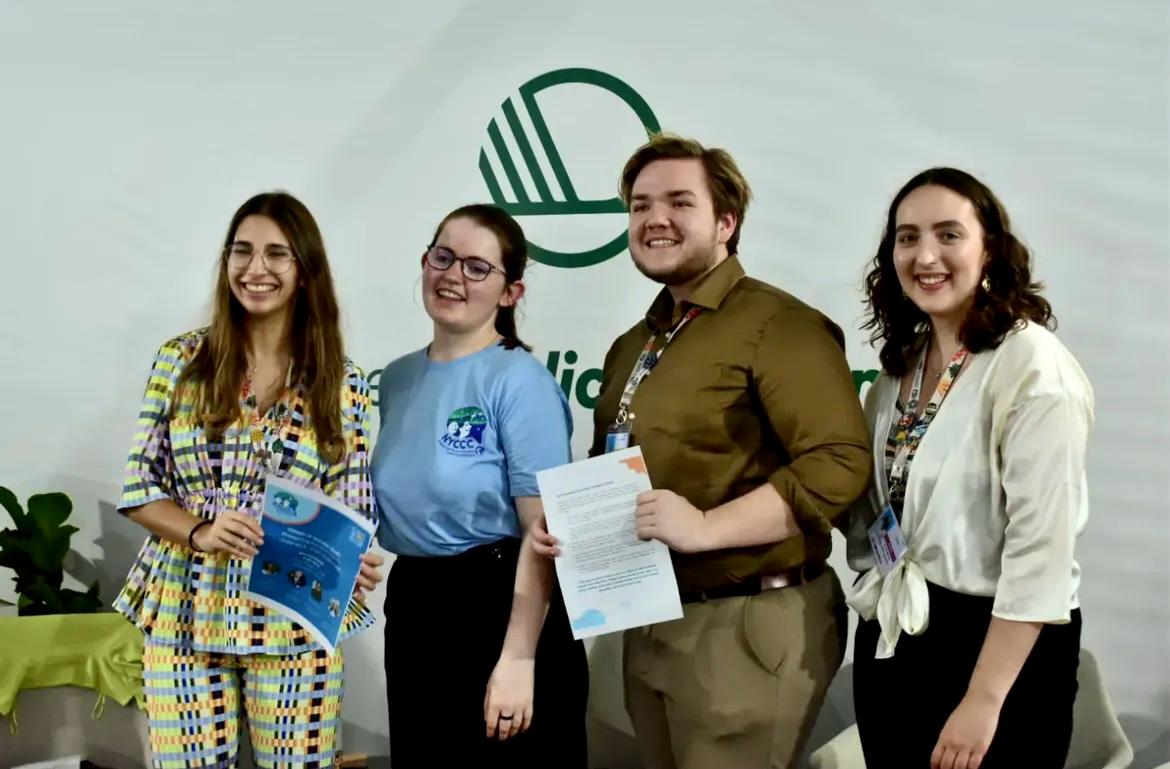
- Presentation of the 1st Nordic Children & Youth Statement (the outcome of our NYCCC) at the Nordic Pavilion and handing it over to Iceland’s Environmental Minister
- Indigenous youth, in particular, highlighted the Amazon’s role as a climate lifeline, stressing that sidelining their voices undermines both justice and solutions
- More and more countries are including Youth Negotiators/ Youth Delegates in their national delegations, so did Germany alongside many other EU countries – and more announced the launch of their programmes (e.g. Portugal and Cyprus)
Looking ahead
For young people, COP30 was not the end but a rallying point. The message is clear:
- Accountability matters: Words must translate into measurable action
- Youth leadership is non-negotiable: Climate justice requires intergenerational equity and gender equality
- The Amazon is a symbol and a test: Protecting it is protecting our collective future and the lives of generations to come
What comes next
COP30 reminded us that youth are not just stakeholders, we are the generation that will live with the consequences and already are. We cannot afford another decade of delay. While COP30 fell behind our hoped achievements, it still showed that multilateralism works.
Now it is time to further prove that it delivers a future for all. After rest and recharge it’s time to gear up for next year. In June the negotiations continue at SB64 and later we meet again for COP31 in Antalya under a Turkish-Australian Presidency. Time will show how this turns out, but what is clear, is that it will need loud, ambitious and engaged civil society to ensure progress – YES-Europe will be back next year to continue our fight for a just energy transition, intergenerational equity and generally climate policies that combat the greatest challenge of our time, climate crisis, in a just and equitable manner.
Leave A Comment